
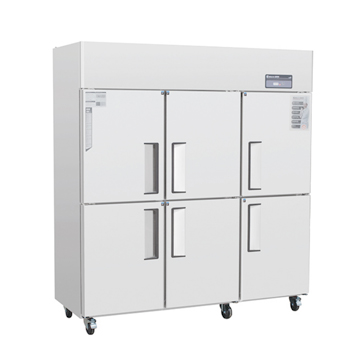
If you run — or supply — minimarkets in Jakarta, the glass-door upright freezer is one of the highest-earning square meters in the store. It sells ice cream, frozen snacks, nuggets, and cold drinks at impulse, and it does it 24 hours a day in 33 °C heat. Pick the wrong unit and you get high electricity bills, warm products, and a compressor that dies inside the warranty period. Pick the right one and it pays for itself in a season.
This guide walks through exactly how to choose a glass-door upright freezer for a Jakarta-sized minimarket — the specs that matter, the ones marketers exaggerate, and the questions to ask before you place a wholesale order.
Glass-Door Upright vs. Chest Freezer: Why Uprights Win in a Minimarket
A chest freezer is cheaper and holds more per liter — but in a small store it loses on the things that actually drive sales:
- Floor space. A chest freezer eats 1–1.5 m² of floor. An upright takes the same footprint but stacks 4–6 shelves vertically, so you merchandise 3× the products in the same tile.
- Impulse visibility. Customers buy what they can see at eye level. A glass front turns the freezer into a backlit advertisement; a chest freezer hides everything below the waist.
- Stock rotation. Shelves make first-in-first-out easy. Chest freezers bury old stock at the bottom.
For a minimarket, the rule is simple: chest for bulk backup storage, glass-door upright for the selling floor.
Step 1: Size the Capacity to Your Store
Capacity is measured in liters (L). Don’t over-buy — an oversized unit costs more to run and looks empty, which actually suppresses sales.
| Store size | Recommended upright capacity | Typical doors |
|---|---|---|
| Small kiosk / warung (under 20 m²) | 200–350 L | 1 door |
| Standard minimarket (20–50 m²) | 350–500 L | 1–2 doors |
| Large minimarket / mini-supermarket (50 m²+) | 500–1,000 L+ | 2 doors |
A typical Jakarta minimarket does well with a single- or double-door unit in the 350–500 L range. If frozen goods are a core category (ice cream, frozen halal meat, seafood), step up to double-door.
Browse capacity options in our Upright Cabinets category.
Step 2: Confirm the Voltage and Plug — This Is Where Imports Go Wrong
Indonesia runs on 220–230 V / 50 Hz. This sounds obvious, but freezers built for the North American market (115 V / 60 Hz) will not work and can be damaged if plugged in. Always confirm in writing that your unit is built for 220 V / 50 Hz with an Indonesian-compatible plug.
If you are buying for multiple markets, a reputable manufacturer can build the same model in different voltages — ask before you order.
Step 3: The Spec Everyone Skips — Tropical (T) Class Rating
This is the single most important spec for Jakarta, and the one cheapest imports quietly ignore.
Refrigeration equipment is rated by the maximum ambient temperature it can still cool properly in:
- N class — rated to 32 °C ambient
- ST class — rated to 38 °C ambient
- T class (Tropical) — rated to 43 °C ambient
A non-tropical freezer placed in a hot, un-air-conditioned Jakarta minimarket will run its compressor non-stop trying to hit temperature. The result: products that never fully freeze, electricity bills 20–40% higher, and a compressor that burns out early.
For Indonesia and the Philippines, insist on a T-class (tropical) unit. ChefSolid builds T-class compressors rated for 43 °C ambient as standard — they’re designed for exactly these conditions.
Step 4: Single Door vs. Double Door — Do the Margin Math
Don’t choose on price alone; choose on return per square meter.
A double-door upright costs more upfront but:
– Holds roughly 2× the SKUs, so you capture more impulse categories
– Has a wider glass front = more “advertising” frontage
– Often only marginally higher running cost per liter
If frozen is a destination category in the store, the double-door usually pays back faster despite the higher sticker price.
Step 5: Energy Cost — Estimate It in Rupiah Before You Buy
Electricity is a recurring cost that dwarfs the purchase price over the freezer’s life. Two things control it:
- Insulation thickness. Look for thick, CFC-free polyurethane (PU) foam. Thin insulation = constant compressor cycling.
- LED lighting. LED interior lights draw a fraction of old fluorescent tubes and don’t add heat load.
As a rough planning figure, a well-insulated 400 L T-class upright draws on the order of 1.5–3 kWh/day in tropical conditions (varies by ambient, door openings, and stock — confirm the rated power draw with your supplier). At Indonesian commercial tariffs, that’s a small, predictable monthly cost — but a poorly-insulated unit can easily double it.
Always ask for the rated power (W) and daily energy consumption (kWh/24h) on the spec sheet, and compare units on that, not just price.
Step 6: The Supplier Checklist — Ask These Before You Order
Before committing to a wholesale order, get clear answers in writing:
- ✅ Is the unit T-class (43 °C ambient) rated?
- ✅ Built for 220 V / 50 Hz?
- ✅ What is the rated power and daily kWh?
- ✅ Insulation type and thickness (CFC-free PU)?
- ✅ Compressor brand and warranty period?
- ✅ MOQ (minimum order quantity) and FOB/CIF terms?
- ✅ Spare-parts availability and lead time?
- ✅ For dealers: is OEM/ODM branding available (your logo, your colors)?
A manufacturer that answers these quickly and in writing is one you can build a long-term supply relationship with. One that dodges them is a risk.
ChefSolid: Built for Tropical Minimarkets, Direct From the Factory
ChefSolid manufactures glass-door upright freezers in a 32,000 m² factory in Shandong, China, and has shipped to distributors across Indonesia and the Philippines since 2008. Every unit is:
- T-class tropical — compressors rated for 43 °C ambient
- 220 V / 50 Hz ready for Indonesia
- CFC-free PU insulation + LED for low running cost
- OEM/ODM available with low MOQ for dealers who want their own brand
Browse our full range in the Upright Cabinets catalog or request a wholesale quote — we reply within 24 hours with pricing, MOQ, and FOB/CIF options for Jakarta delivery.